[ Content | Sidebar ]

Link Tracking Broken by Twitter …

Unfortunately Twitter’s recent move to exclusively support their t.co link shortening has broken our link tracking features in Twitalyzer. We continue to look for a way to resolve this problem but in the interim our Link Clicks and Link Clicks by Day reports are functionally offline.

We are sincerely sorry for this and will keep you all posted as we work to resolve the issue.


PeerIndex data loss for the past few days

Just a quick note to our customers who have noticed that PeerIndex data showed zeros for the past few days. PeerIndex suffered an Amazon Web Services (AWS) related outage this week and were unable to provide data via their API. This has been corrected and we are sorry for the data loss.


Now in BETA: Communities and Saved Reports

Those of you paying attention have likely noticed that we are starting to leak version 5.0 BETA reports and functionality into Twitalyzer. Two items of note are the ability to save any report for easy access and our expanded “Community Analysis” reports.

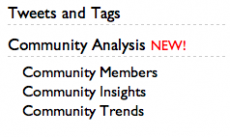
You’ll find the community reports under “Tweets and Tags” in the navigation menu. We’ve gone ahead and created an entire category for these reports — essentially all things having to do with hashtags (which we think of as “communities” in Twitter) — since we will be adding even more functionality and reports over the coming months.

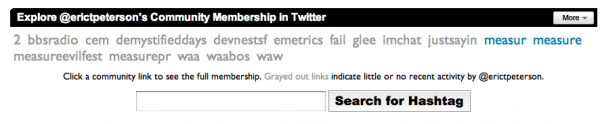
All three of these reports start with a high-level view of the communities each of your tracked accounts participates in:

The grayed out links show you which communities you have participated in sometime in the past but are not currently active in. The blue links are those communities you have contributed to in the past seven days. Clicking on any of these links will activate the report, or you can search for any “hashtag” (e.g., community) that you might be interested in.

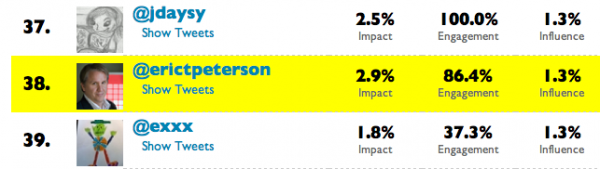
The Community Member report details the key Twitalyzer metrics for each Twitter user participating in that community that is currently being tracked by Twitalyzer. That last point is important — we don’t know everyone — but you will notice at the bottom of each community report we are including information about those people we do not know so you can add them in for processing.

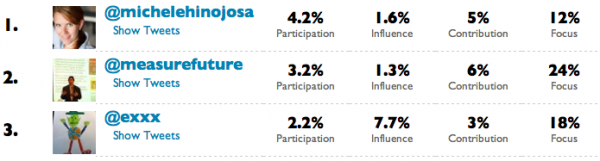
The Community Insight report (previously just called “Community”) goes much deeper than the membership report, detailing a number of new metrics about recent community participation.

In the Insight report you will find four new metrics — Participation, Influence, Contribution, and Focus — providing great additional detail about recent activity in the community. Want to know who is the most active member in your community? Look to Participation! Want to know who has the most influence, or who contributes the most original content (e.g., not retweets)? See Influence and Contribution. Finally, Focus is a measure of the relative number of that individual’s tweets that are “in community” — for example, 18% of our friend @Exxx’s tweets last week were posted to the #measure community.

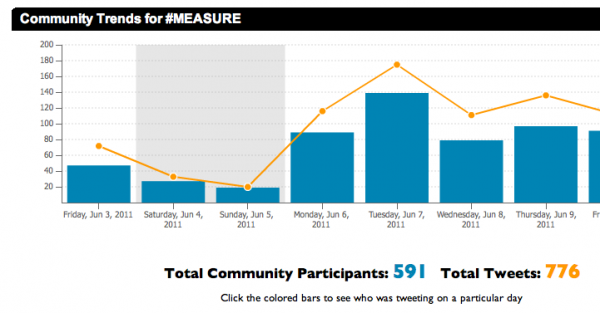
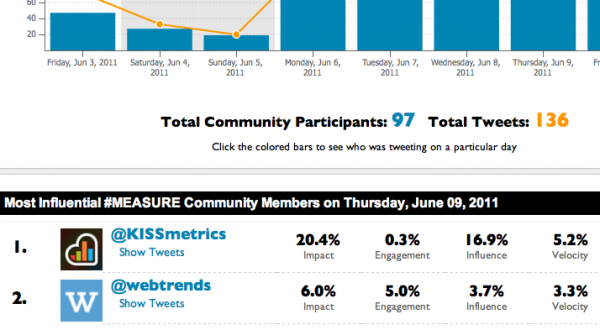
Going deeper still, the Community Trends reports will detail levels of activity over the past seven days for any community you are part of. We highlight both number of participants and total tweet volume.

When you click on any individual day (bar or data point) you will be shown each person we are tracking that was participating in that community on the given day.

So now, all of the brands and agencies of the world who are running community-based marketing campaigns have immediate access to participation volumes and a complete list of participants, all for as little as $4.99 per month.

How cool is that?

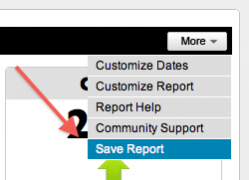
While slightly less involved than our community reports, we are also happy to release our “Saved Reports” functionality into the wild. Now, under the “More” button on every report, you have a “Save Report” link. Clicking that link will give you an option to save the report by providing a name and, optionally, a brief description of the report.

This works for any report you can configure! The “Find New” reports, so that you can save your criteria for exploration; all of the various “Trends” reports we provide, so that you don’t have to re-select metrics and timeframes; and any other report we provide today.

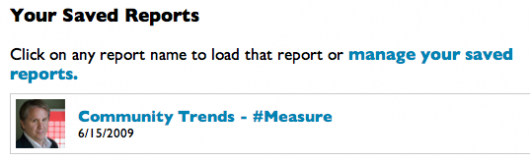
To access your saved reports simply click the link in the navigation menu on the left of the page and a pop-up will appear listing each report you’ve created by the account it is associated with.

It is that simple. Awesome, huh?

Anyway, these are just a few of the updates we have in the hopper for version 5.0 that we wanted to get out sooner than later. We have a lot of other stuff planned including better multi-account functionality, better Export and data-access options, and a handful of new reports that we have been working on for months.

So watch this space …


Twitalyzer: Now with 300% more Klout!

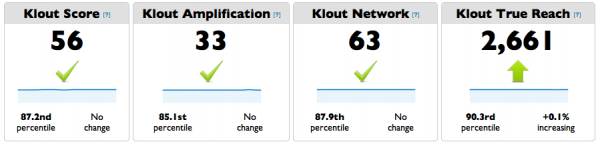
In our never-ending quest to provide the most robust, useful, and complete measurement and analysis platform for Twitter we are always looking for data we can add into Twitalyzer. After a great conversation last week with Klout’s new Vice President of Platform we realized we had exactly that right in front of us for the taking, namely Klout’s Amplification, Network, and True Reach scores. And so, thanks to a little coding and a day of patience while Klout solved a small problem on their end, we are happy to announce the expansion of Klout data in Twitalyzer!

Next time you go to your Metrics and Measures > Metrics reports you will see the following down towards the bottom of the page:

(Keep in mind you may need to reprocess your data for scores to appear. If you see “0″ values and you know you have Klout go back to your Metrics and Measures > Profile page and click the “Click for real-time update” link.)

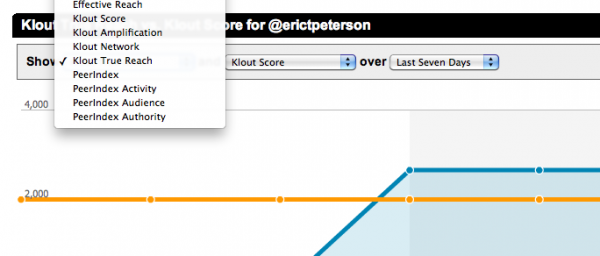
We didn’t stop there, of course, and have added all of the Klout data to our various “Trends” and “Find New” reports (which are limited to paying customers only … hint, hint.) Here you can see how the Klout data shows up in the trends reports.

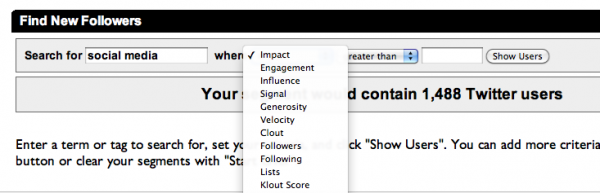
One of the most exciting things about this integration is that we are now incorporating Klout’s “subject matter” data into our “Find New Followers” report. Now, not only can you search for a variety of topics and subject areas (try “social media”, “google”, or “linkedin” for example) and filter against both our core Twitalyzer data and both Klout and PeerIndex’s primary scores:

We hope those of you who are fans of both Twitalyzer and Klout will appreciate this integration. We’re starting to work on our version 5.0 release (due this summer) and in addition to the Klout data addition we are leaking new reports and data into our interface including:

  • Network demographic data, now available in each Twitter user’s profile. We have hundreds of thousands of points of data from Rapleaf detailing user location, age, and gender and so are looking now at unique and interesting ways to make this data available.
  • Added a new “Benchmark” report to allow you to compare your use of Twitter to any list, community, or subject grouping. Similar to our “Comparison” report, you can now directly compare your account to an aggregate, for example, all of your co-workers who Tweet, your competitors, or any Twitter community you belong to. CUSTOMERS ONLY.
  • Activity by activity comparison, letting you see how two different metrics trend versus each other over time. This is one of our favorite new reports! You can now see how your Twitalyzer Impact and Klout Score change over time, all in one place. Or compare your addition of followers to re-tweets, mentions, or updates you post. CUSTOMERS ONLY.

There are some other things running behind the scenes that we will be releasing slowly over the coming months leading into the official version 5.0 release. If there is a feature you’d like to see, let us know on Twitter, over email, or via our great GetSatisfaction community!


An Apology to Our Customers

Well by now I am quite sure that you have noticed that Twitalyzer got some press attention over the last week. Thanks to David Leonhardt at the New York Times Magazine and his article on “A Better Way to Measure Twitter Influence” we have been featured in USA Today, Politico, Business Insider, The Hill, Media Bistro, Variety, and various other NY Times blogs and articles. Even better, our site and data has been discussed on ABC News and our CEO, Eric Peterson, was interviewed twice on MSNBC (much to the chagrin of his family we assure you.)

Not bad for a boot-strapped start-up, huh?

While we are honored by the attention, one really unfortunate thing happened in the midst of all of this … we let our paying customers down. Because of the traffic deluge last week our databases were over-run and could not keep up with processing. Even if that hadn’t happened, it would not have mattered, since our Twitter-given API limit was exceeded for more or less the entire day.

In the end we failed to do the one thing you pay us to do: track your accounts each and every day.

To make it up to you, our loyal and paying customers, we are happy to do the only reasonable thing: For everyone who was a customer as of Friday, March 25th, we will gladly refund your entire month’s fees for March via Paypal if you would like.

We let you down, and because we let you down we firmly and strongly believe we need to make it up to you. Refunding your money is the least we can do, but hopefully all of you will see this as a small token of our appreciation. We are becoming a great company and a great Twitter analytics brand because of you … and for that we thank you.

If you would like the refund all you have to do is email us and ask, no questions asked. If, however, you understand that “these things happen” we appreciate that and we promise to be better prepared when the next media deluge happens. In a way we already are … of course last Friday it sure didn’t seem like it.

So let us know if you’d like the refund and we will get that processed right away. In the meantime we just wanted to thank you all again for your support of the work we are doing here at Twitalyzer. We have great things planned and we are encouraged to have so many great companies traveling with us as we grow.

Sincerely,

Eric Peterson
CEO and Founder, Twitalyzer
@erictpeterson


Twitalyzer Service Update: Friday, March 25th

Well, you may have noticed by now, but thanks to a great article published in the New York Times blog which has since been picked up by Globo, USA Today, Politico, Silicon Alley Insider, and a few dozen other outlets, Twitalyzer’s service is best described as “spotty” today.

Please follow us @Twitalyzer and we will send out updates as the service recovers.

We are honored by the article and really, really excited to see the print piece in New York Times Magazine this coming Sunday (March 27th) We are also super, duper sorry for the service interruption and the impact on our customers.

UPDATE: We will have an email out to paying customers by Monday to explain the service outage in detail and share what we are going to do to make it up to you. The fact that paying customers are locked out of Twitayzer is unacceptable and we promise to make it up to you!


Companies Must Not Rely on a Single Score

Jeremiah Owyang (@jowyang) demonstrated yet again why he is at the top of his game when it comes to social strategy with his post on “Klout for Business: A Useful Metrics but Incomplete View of your Customer” published earlier today. Jeremiah is well known to me, having interviewed me back in the day and, more recently, for having worked with John Lovett and I on our Social Media Measurement Framework over at Web Analytics Demystified. If Jeremiah is not on your “must read” list … shame, shame on you!

As I read his most recent piece on measuring social media I was pleasantly reminded of how much Jeremiah’s thinking has influenced our work here at Twitalyzer. His point that special treatment for select customers isn’t anything new at all, and that relying on a single metric for “influence” is dangerous, is absolutely spot on. If you haven’t already, be sure to give the post a read.

Jeremiah offers up a handful of cautions worth mentioning here since they are relevant to our work on Twitalyzer and the value we believe we provide for the social business:

Don’t alienate mainstream customers to serve “influentials.” The reason we provide such a broad set of metrics in Twitalyzer (link to @Jowyang’s metrics) is that web firmly believe that there is goodness in nearly every social relationship and every customer or prospect. They may not have “Klout” but everyone talking to, with, and about your brand in Twitter is worthy of your attention. With Twitalyzer we help you easily discern the characteristics of those individuals without simply assigning them a single, crappy score.

Consumers will game the system, without a doubt. It’s already happening … so much so that the attention our niche has attracted from major media is increasingly turning to efforts to “cheat” influence scores. Cheaters never win, but they will also never stop trying, and the more cheaters there are, the more suspect easily gamed systems become.

At Twitalyzer we don’t think social media is a game and have removed nearly all of the major incentives individuals have to “cheat” our scoring algorithms. We are transparent, easy to understand, and “cheating us” doesn’t get you airline tickets, into bars, or job interviews … it just highlights that you are willing to cheat to win, which is #fail.

These measures are not representative of real influence. What our system, Klout, PeerIndex, and others measure is activity and behavior in Twitter and other “social media” channels, not “influence.” Sure, we use that word — and we do, although we have a very transparent and very conservative definition of the term — but don’t fool yourself, it doesn’t translate to the real world. Worse, if you try and make that leap, you could end up making a horrible decision.

Take, for instance, the fine folks at Klout’s translation of their measure of influence as a basis for Grammy Awards predictions. By my measure they only got 40% of their predictions correct, which suggests a very poor correlation between “social influence” and “influence over people voting for Grammy awards.” To be fair, I wouldn’t have picked Esperanza Spalding over Justin Bieber either, but the magnitude of the miss on these predictions should give anyone trying to make a decision with ANY single score pause.

Without sentiment the gauge is incomplete. Sentiment is hard as hell, trust me, and we barely scratch the surface with what we are able to do. But I will take this point a step further and argue that “without context the gauge is incomplete.” This is why, again, we provide a diverse set of metrics INCLUDING Klout, PeerIndex, and others, as well as a complete archive of the user’s recent Tweets. Consider the whole individual, including their Tweets, and you get a better picture of who you are dealing with.

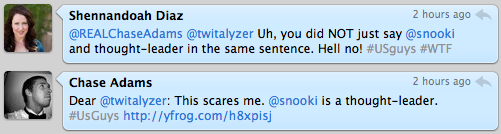
This is especially useful if you harbor particular social biases … say, against Nicole Polizzi (aka Snooki aka @sn00ki) as our friend Chase Adams (and others) do.

Relying on a single metric alone is dangerous. Agree. Fully. So much so that I penned a little piece that got a lot of attention a few weeks back. Shel Israel pointed out one danger of this, Jeremiah does another … and the list will keep on coming until businesses wake up and realize the danger of taking Twitter and these “silver bullet” metrics out of context.

Influence is not a gauge of true buying potential. Leave it to the social strategies to tie this back to the one number that makes a difference — revenue. A “high Impact” Twitter user might say nice things about you … but if they don’t drive traffic and revenue, how influential are they really? We have had some amazing folks drive huge volumes of traffic to us … Robert Scoble, Guy Kawasaki, Pete Cashmore, Shel Israel, and yes, even Jeremiah Owyang … but I can assure you, they don’t all drive revenue the same way.

We believe revenue is important, so much so that we have the industry leading integration with Google Analytics (the most popular analytics platform in the world) to help our customers tie Twitter users and Twitalyzer data back to cold, hard cash.

When brands are considering relative influence (Jeremiah’s words) we think you need to be considering the circle you work in. I personally have a lot of love for the web analytics (#measure) community and so spend a lot of time thinking about Twitalyzer’s “Communities” report. The Communities report takes any hashtag and breaks the group of people using that report down into participants, influencers, and contributors while detailing all of their key metrics in our system.

Customers find this useful as an input into their own formulas. Perhaps you would too.

Anyway, I apologize for fawning somewhat over Jeremiah’s post but it seems like every time I turn around someone else is cheering for the “single score” crowd. Like Jeremiah, we at Twitalyzer think this is wrong, dangerous, and disrespectful of Twitter users around the world.

I welcome your comments.


Social Media is not a game

Some of you probably read the Wall Street Journal article “Wannabe Cool Kids Aim to Game the Web’s New Social Scorekeepers” published last week. While we are incredibly honored to have been discussed on the front page of the Journal, I have to say I am pretty disappointed with the article overall. Specifically, despite repeatedly clarifying otherwise to the reporter, Twitalyzer is not a social scorekeeper. Why not, you ask?

Because we don’t think that social media is a game.

Yes, people are infatuated with their social scores, perhaps to the point of narcissism according to my brilliant friend John Lovett. And yes, companies like Klout are getting tons of milage out of their “perks” program for “social influencers” which is a great reminder that people love free stuff. But when we arrive at the point where people are “gaming the system” and are making hiring and firing decisions based on a calculated metric that may or may not be transparent, our big, blue robot starts screeching “Danger, Will Robinson, Danger Danger!”

From where I sit social media is a huge and growing business. A study reported by Business Insider recently found that 75% of small businesses will be doing more marketing in social media in 2011 and that as many as a third (34%) will be spending as much as half their time and budget leveraging social channels for marketing and customer acquisition.

Why?

Simple. Done right, social marketing works! The same study reported that nearly two-thirds (63%) believed that social marketing had increased sales and revenue and 40% of these folks said that the increase was “significant.” Who doesn’t want increased sales and revenue, especially from a channel that is essentially free to use (although that may be changing, according to All Things D’s Peter Kafka.)

At Twitalyzer we are dead serious about what we do and about the data that we provide. That is why do things like:

It may not seem like much, but at the end of the day we think it is important. See, Jeff and I aren’t just engineers who chose Twitter as a development platform because the API was (or at least used to be) free. We are digital measurement specialists with over a decade of experience developing, writing about, evangelizing for, and actually using analytics to help companies grow their businesses, online and off.

You may think it’s crazy, but we think it means something.

So I guess I apologize for not being more appreciative about the Journal piece, but Twitalyzer cannot be gamed. People have tried to run up their scores — and I can assure you, it can be done, at least for a short period of time — but in the long run any individual who “games” our system only hurts themselves. In order to jack up your Impact and Influence scores you will either need to cheat by “buying followers” or “pumping and dumping” or viciously abuse your audience with pointless RT’s, link spam, and other crap.

Either way two things will happen:

  1. Your followers will leave you, easily sensing that you are no longer genuinely engaged in Twitter
  2. Your other Twitalyzer scores — Generosity, Engagement, Signal, Velocity, etc. — will give you away

At the end of the day cheaters never win. What’s more, since we aren’t going to send you a free flight coupon, let you drive a car, or let you into a club because you have a high Twitalyzer score, there isn’t anything to win so why bother?

We don’t think social media is a game. If you do, great, there are dozens of services out there to stroke your ego, play to your narcissistic side, and generally deliver big numbers to make you feel good about your participation in the medium.

But if you are a business owner looking to better understand which of your efforts in Twitter have a measurable business impact, if you are allocating costly resources or paying an agency to represent your businesses interests 140 characters at a time, or you are one of the hundreds of thousands of companies who are planning to spend more time on social media marketing in 2011 we have two words for you:

Call us.

In the meantime we encourage you to take Trey Pennington’s advice about how to cultivate influence in Twitter: “Just use whatever gifts you have to help other people accomplish their dreams. If you’ll help enough other people get what they want, you’ll have all the influence you’ll need.”

I welcome your thoughts, comments, and criticisms of this post.

Sincerely,

Eric Peterson
CEO and Founder
Twitalyzer, LLC.


Thoughts on “Thought Leadership”

Every now and again friends of Twitalyzer will send us a note saying something like this:

While we certainly understand people’s sentiment we wanted to offer a single, simple caution: Just because you don’t recognize another Twitter user’s greatness doesn’t mean they aren’t great.

In this case, Mr. Chase Adams is referring to reality television star Nicole Polizzi, aka “Snooki” or, in Twitter @sn00ki. Say what you will about Ms. Polizzi, she rocks Twitter in a big way as evidenced by her complete set of Twitalyzer metrics.

This raises an important point about our influencer types and, more broadly, the way Twitalyzer is used. Our influencer types — “Everyday User”, “Reporter”, “Social Butterfly”, “Trendsetter”, and “Thought-Leader” — were derived from Lisa Barone’s “Five Types of Influencers on the Web.” While Chase may be frightened by the prospect, it is pretty hard to make the case that Dear Snooki isn’t being listened to, responded to, and shown the respect of her community in Twitter.

Put another way, young Nicole may not influence Chase (or us for that matter) but she does influence some percentage of her 1.06M followers and the nearly 1.3M people in Twitter she is effectively reaching right now. While it may inspire, shall we say, an unpleasant response from some, when you apply an objective lens to any individual’s use of Twitter you never know what you might learn.

More importantly this somewhat glib exchange highlights the value of having access to a number of different data points to describe a Twitter user’s use of Twitter. The evidence of Nicole’s greatness (in Twitter) appears throughout her measures and metrics in our service:

  • She currently has 1.12M followers, up over 5% from a few days ago
  • Her Impact and Influence scores are both in the 100th percentile
  • Her Clout, Referenced, and List scores are all in the 99th percentile
  • Her Retweet Ratio is 137:1
  • Her Klout and PeerIndex scores are both in the 99th percentile

Again, like her or not, Snooki rocks. And yes, I am going to burn in hell for writing that.

Long story short is this: Before you declare yourself greater than Snooki, Michael Jackson, or any other Twitter user, take a step back and think about what our data is really saying. Per my “Twitalyzer and Klout” post last week, we aren’t saying ANYTHING about the individual as a person; we are merely assessing their use and interactions in Twitter.

Armed with that information you’ll hopefully feel better about our data, learn something, and hopefully benefit from the insights that Twitter and Twitalyzer has to offer.


Twitalyzer and Klout

I just wanted to drop a note and give a hearty congratulations to Joe Fernandez and the team from Klout on their $8.5M funding round this week. Clearly Joe and his team are onto something with their quest to become “the standard for influence” in the social web and so we congratulate them on that!

When I first met Joe last summer in San Francisco and we chatted about what we wanted our respective companies and platforms to become Joe was clear: he wanted to be the “Nielsen of Social Media,” a public aggregator of social influence metrics that could be used to determine the, well, social clout of any individual. Regardless of whether you agree with your Klout score, based on the great marketing work Joe’s team has done this year, you have to agree he is doing a great job executing on his vision.

During the same meeting Joe asked what Jeff and I wanted Twitalyzer to become. My response? “The Google Analytics of Twitter.” Whereas Joe’s goal has been to be outward-facing, our goal all along has been to become a business platform used internally at companies trying to measure the effectiveness of their presence in Twitter. To that end we have iterated the product four times, most recently launching version 4.0 on January 2nd, and added hundreds of companies who share our vision.

It’s not $10M, but we’re not beholden to anyone and we’re wildly profitable (for those of you counting at home.)

I bring this up because recently Shel Israel brought to our attention a specific use of Twitalyzer that honestly makes me uncomfortable. Shel related a story of a social media consultant who had been passed over for some work because he had a “low Twitalyzer score.” Shel, using himself as an example, made the comparison between himself and Michael Jackson (the deceased pop-singer who still manages an update or two a week.) The big “oh crap” comment was:

“I have low confidence that many people will like to contract [a social media consultant] whose score is 13.1%.”

Here’s the thing: I personally think that any company or individual who is making a hiring or contracting decision based on our data, Klout scores, or any number is making a huge mistake! I expressed this much to Mr. Israel and I think he understood:

“They made it clear that they did not intend for their product to be used in the ways I described and I think I made clear that at least a few people are using it in precisely that way.”

Our data is designed to objectively evaluate your efforts to use Twitter for a business purpose and to make comparisons against other businesses and individuals taking a particular approach towards the medium. We provide over 30 different metrics so that YOU can decide which measures of success are right for you, and our goal is not to be some type of divining rod for influence or any other type of social capital.

Right, you say, so what about our benchmark reports and all of the comparative stuff in the application? A reasonable challenge, but hopefully some of you noticed that in the 4.0 release we have included a very complete set of metrics in every comparative report and, more importantly, we allow you to order your benchmarks by whichever criteria you choose. Also, in version 3.0 last year and as a general rule we have moved away from “influence” as a primary metric, instead preferring our “impact” calculation which we think A) is more comprehensive and B) is much more well-aligned with a business use of Twitter.

We did explain to Mr. Israel that a 13% score for impact is actually very, very good … better than 97.7% of the hundreds of thousands of individuals we are tracking in Twitalyzer. We also have an update in version 4.1 which we call “Shel’s fix” that should be out soon that will do a better job of highlighting percentile scores which I believe are equally valuable to the averages and raw data we present.

But the fact remains, and I want to be very clear on this point, to use Twitalyzer (or Klout for that matter) to make any decision about an individual other than broadly how they use Twitter as a tool is a mistake and does disservice to the individual, Twitter, and our analytics platform.

No disrespect to Joe, Klout, or any of the other measurement services out there, but there is no calculation that tells you nearly enough about an individual to allow you to make a buying, hiring, or any other kind of personal decision. At the point where we are making personal decisions based on a single number — one that even in a transparent system like ours people still don’t take the time to understand completely — our humanity has been lost and, in my humble opinion, we are better off turning the damn machines off and calling it a day.

Use Twitalyzer data to determine whether the things you are trying are working; use Twitalyzer data to explore how other people use Twitter in an effort to find people who can help you with your goals; use Twitalyzer data to understand who has an outsized impact in this still emerging medium … but please, please, don’t use Twitalyzer data to decide whether to take a phone call, respond to an email, or reply to a tweet.

I welcome conversation around this point, either in public via my personal Twitter account (@erictpeterson) or in private via email (eric at twitalyzer.com).